
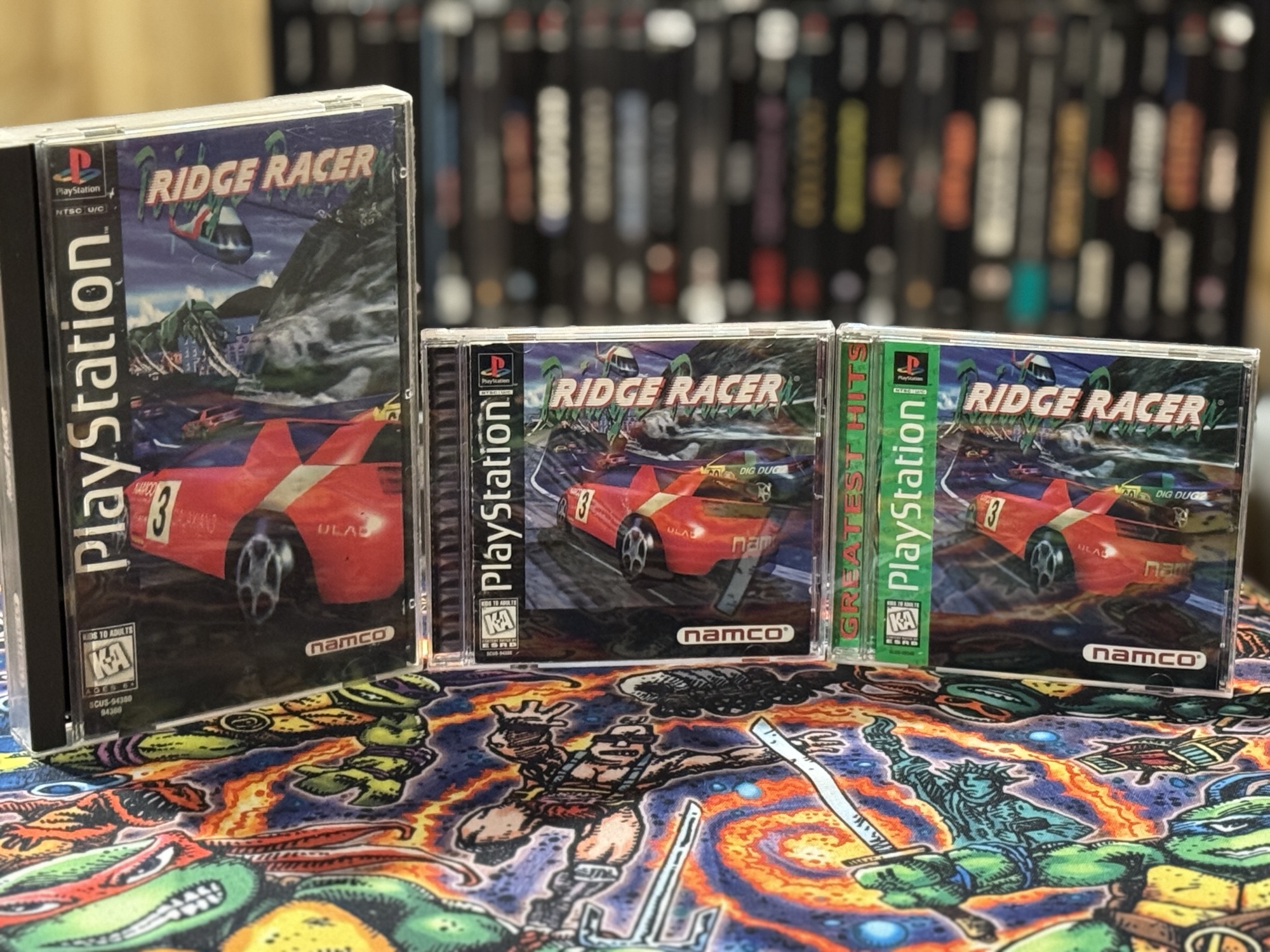
With a library of over 1,200 original PlayStation games, it is understandable for some people to ask me if I have the “whole set”, or close to it. It makes sense since there’s (allegedly) 1,278 games released here in North America for the console. In reality, the number of unique games that I own 15-20% less than the overall number. The rest of the games are variants.

There are several types of variants. The most familiar example is the Greatest Hits re-release. When a game sold a certain number of copies in its initial release, there was a chance that it would be picked up for re-release at a lower price point. A lot of collectors really don’t like the Greatest Hits branding and its green color, and some will outright ignore these when building their libraries. It’s understandable to want a uniform-looking collection, but there are reasons to consider Greatest Hits copies– whether you’re a collector, a player, or both:
- For players and or collectors starting out, Greatest Hits copies are often less expensive than their Black Label counterparts, while offering the same game and content in most cases. More on the “content” in a bit.
- Interestingly, a few Greatest Hits variants can be more valuable than their Black Label mates. As an example, PriceCharting shows the original, Black Label release of an innocuous sports game like Madden NFL 98 at around $8USD for a complete-in-case copy. The Greatest Hits variant, however, runs at close to $23USD– or about three times the value. An extreme example is NFL Blitz 2000, where the Black Label copy is about $15… but the Greatest Hits variant commands more than $10,000!
- Finally, there are Greatest Hits versions of games that have been improved over their Black Label forerunners. Mortal Kombat Trilogy and Gran Turismo 2 are the most well-known cases of this, while Jet Moto 2, Spyro: Year of the Dragon, and The Lost World: Jurassic Park are other examples.
Another variant type is the jewel case re-release. After initial runs in “longbox” cases, some games got successive runs in jewel cases. WipEout, Warhawk, Wing Commander III, NFL GameDay, NHL FaceOff, Tekken, Battle Arena ToShinDen, and Ridge Racer are examples of this. Jewel case variants can sometimes be much more valuable than any other version of a game. Ridge Racer is the best example of this scenario. Using PriceCharting as a base once again, the original Longbox release of Ridge Racer runs for around $30USD, while the Greatest Hits version is about half that value. The jewel case variant, though? $675USD– more than 20 times the value of the Longbox. (And I have all three!)

The last of the notable variant types is the Collector’s Edition. These come from box sets that were re-released rather late in the PlayStation’s lifespan and bundled common games together at one low price. There’s an Army Men set, a Crash Bandicoot set, a Spyro set, an EA Sports set, and a few others. It’s getting increasingly more difficult to land the cardboard box these come in, but the games themselves are easier to find. They’re usually not a valuable add to a library, but are interesting to own. I have quite a few of these, but not all of them.

There’s a sporadic few other variants to mention that are in my library. Shadow Madness had multiple releases– the initial release came with a Jade Cocoon demo disc, while the secondary release did not. Crash Bandicoot 2 & 3 have special cover variants. I’m sure that I’m missing a few other examples, but I’m going off the top of my head.
My collection is more comprehensive than complete or in pursuit of a “full set”. For example, I don’t own any of the Spec Ops or Rainbow Six releases as I have zero interest in playing them. Some high-value games like Fox Hunt and Persona are out of my range and I rarely see them in the wild. A “full set” of games was never really the intent for me, even though I’m probably most of the way there. I find the variants interesting, and wound up getting into adding them pretty late in my collecting journey. They don’t really add to “completeness”, but are instead a fun way to look on a game’s history over multiple releases. In many cases, multiple variants or releases tend to indicate some level of success (or desired success) for games.
Leave a Reply